
This series introduces Harvard Business School AI Institute Associates Program projects which aim to answer important questions at the intersection of artificial intelligence and digital technologies in business and society.
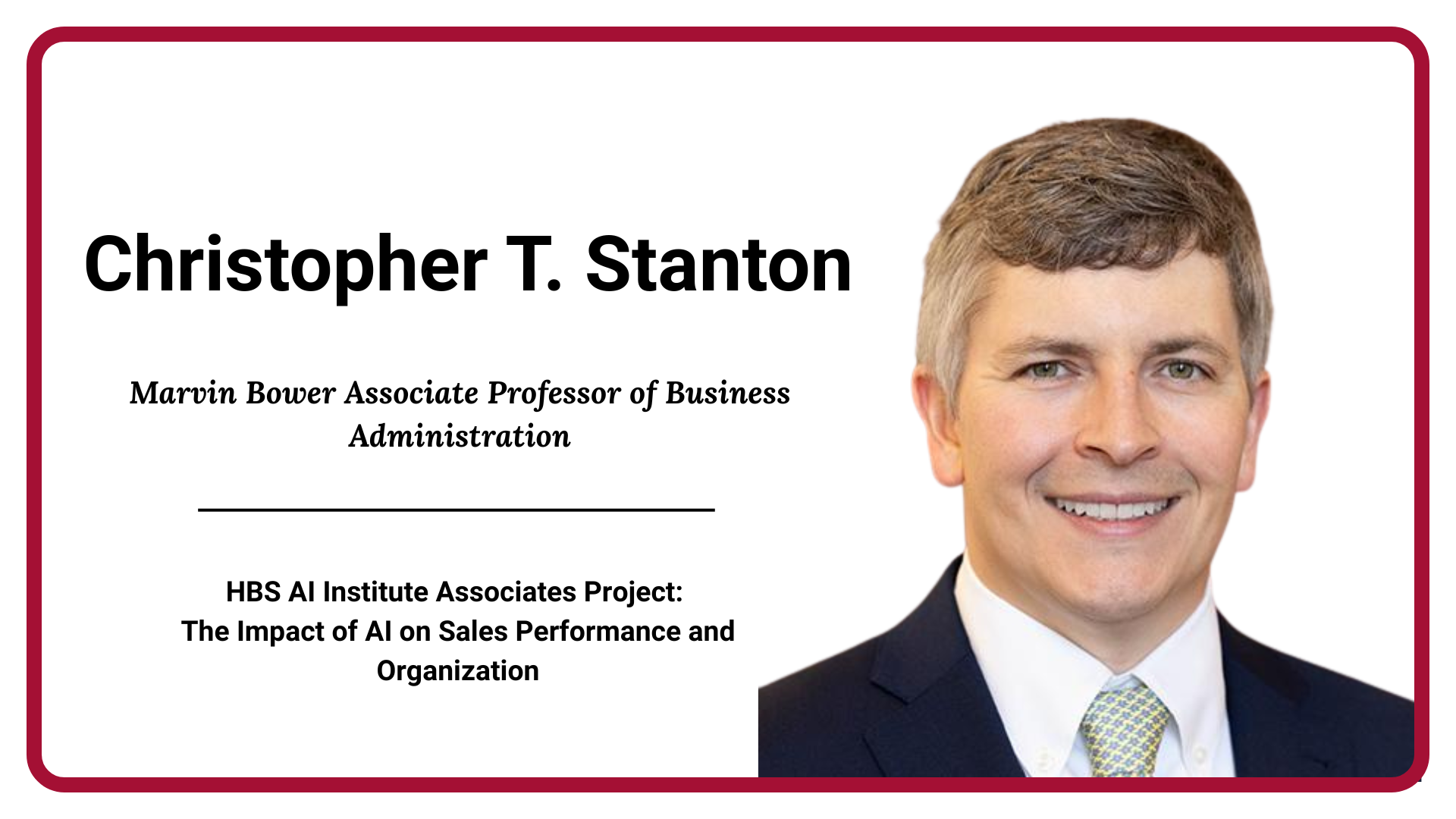
This article shares insights from Christopher Stanton, Marvin Bower Associate Professor of Business Administration at Harvard Business School who is pursuing research on the topics of artificial intelligence and organizations.
1.What drew you to this area of research and how did you first become involved in this work?
I have long been interested in how new technologies change work — not only whether they increase productivity, but who benefits, what skills become more valuable, and how organizations need to redesign jobs to capture the gains. Generative AI has made those questions much more urgent. A great deal of early AI research has focused on relatively narrow tasks, but many important jobs are bundles of activities that have different levels of overlap with AI. Sales is a particularly useful setting because it is complex, but it also has relatively observable outcomes such as revenue, win rates, quota attainment, and cycle time.
Relative to AI deployment in simple contexts, where lower performing workers catch up, I thought we would see the opposite pattern in sales. My thinking stemmed from the observation that a typical sales rep might spend less than half her time working with clients; the rest is spent on research and administrative work. If you can reduce the time commitment on the admin side, the best reps can handle more accounts, lifting their numbers.
I became involved in this particular project through conversations with Justin Shriber, the CEO of Terret.ai, which helps organizations filter context for better AI-deployment in the sales function. We then worked with the Bain Capital Ventures CRO Advisory Counsel to combine interviews with executives and original survey evidence from sales teams.
2. What are some common misconceptions or barriers around the problem you’re working to solve?
One common misconception is that AI’s effect on work will be the same across all jobs or all workers. In some settings, AI appears to help lower performers catch up by giving them better templates, answers, or guidance. But in more complex jobs, such as sales, AI can also amplify the best performers because they use the time saved from routine work to prepare better, pressure-test strategy, understand customers more deeply, and focus on higher-value interactions.
A second misconception is that deploying AI tools automatically creates productivity. Time saved is not the same thing as productivity gained. Organizations still have to redesign workflows, train people to use the tools well, create guardrails, and decide what work should remain human. In our research, AI literacy (but not trust in AI) appears to be a key factor in whether workers translate AI access into better performance.
3. What research is being done on this topic and how is your approach or perspective unique?
There is excellent emerging research on AI in customer service, writing, software engineering, and other settings. Much of that work has shown that AI can be especially helpful to less experienced or lower-performing workers in relatively focused tasks. Our approach is different because we are studying AI in a more complex, multi-task job where workers must combine analysis, prioritization, customer judgment, and relationship-building.
Sales gives us a distinctive lens. The job includes many tasks that AI can touch — prospect research, lead qualification, content creation, deal execution, forecasting, coaching, and internal navigation — but it also depends heavily on human trust and judgment. We are combining quantitative survey evidence with qualitative interviews from leaders at frontier sales organizations. One of our headline findings is that, among 32 managers in our survey, 78% reported that top-quartile reps experienced higher-quality output from AI, compared with 62% for bottom-quartile reps.
My initial expectation that high-performers would see more or higher-value tasks because of time savings with AI is mostly borne out in the data. But the fuller mechanism is not just that top performers save time; it is that they use AI to improve the quality of high-value work. They are better able to prioritize what matters, to pressure test negotiation strategies, and to tailor offers to a customer.
4.What excites you most about this work and its potential impact?
What excites me most is that this research can help managers move beyond broad claims like “AI will replace workers” or “AI will make everyone more productive.” The reality is more nuanced, which leads to managers needing to exercise judgment about how to deploy AI, and where. AI is changing the task mix inside jobs. It automates some work, augments other work, and has very different effects depending on the tech stack, team organization, and governance decisions around data access and tool use.
What’s particularly exciting is that we’re documenting in real time how managers are adapting, how organizations are changing, how high-performers’ career paths are changing and accelerating, and how leaders are learning from experiments to drive change.
5. How do you hope working with the HBS AI Institute will amplify the impact of your work?
My hope is that working with the Institute will help us reach both academic and managerial audiences. The goal is not just to document AI adoption, but to help leaders understand what conditions make AI productive, what risks need to be managed, and how organizations can redesign work responsibly.
6. What changes do you hope to see in your field as a result of the work being done in this area?
This stream of my work is very practitioner oriented. I hope it encourages leaders to treat AI adoption as an organizational redesign problem that must happen in conjunction with a software procurement problem. The companies we are studying are rationalizing their tech stacks, building their own tools where proprietary context matters, and changing the interface between workers and software. A useful managerial principle is: centralize the context, decentralize experimentation, and productize the best ideas. That means leaders need strong data infrastructure and guardrails, but they also need frontline experimentation and peer-to-peer learning.
7. What’s an essential area in which AI and digital technologies will reshape the way businesses or society operate in the long run that we may not be considering?
One underappreciated area is how AI will change the human-computer interface inside organizations. The enterprise software stack in sales previously asked workers to adapt to systems: enter data into the CRM, search across tools, fill in fields, and move information manually from one system to another. AI is beginning to reverse that relationship. Increasingly, workers will interact with agents that pull context from many systems, make recommendations, draft outputs, and guide next steps inside the flow of work.
That shift has major implications for organizational design. It changes what needs to be centralized, what can be decentralized, how junior workers learn, how managers coach, etc. How AI changes the architecture of work itself will be a fascinating question where we’re just scratching the surface.
Over time, this tension will force firms to rethink governance, oversight, and liability. The key question will not only be whether AI is accurate, but who is responsible when collaborative systems fail. Designing systems that preserve meaningful human agency and attention is therefore not only a performance issue but also an institutional one.
The Harvard Business School AI Institute Associates Program supports and accelerates faculty research into the ways AI and digital technologies are reshaping companies, organizations, society, and practice.