

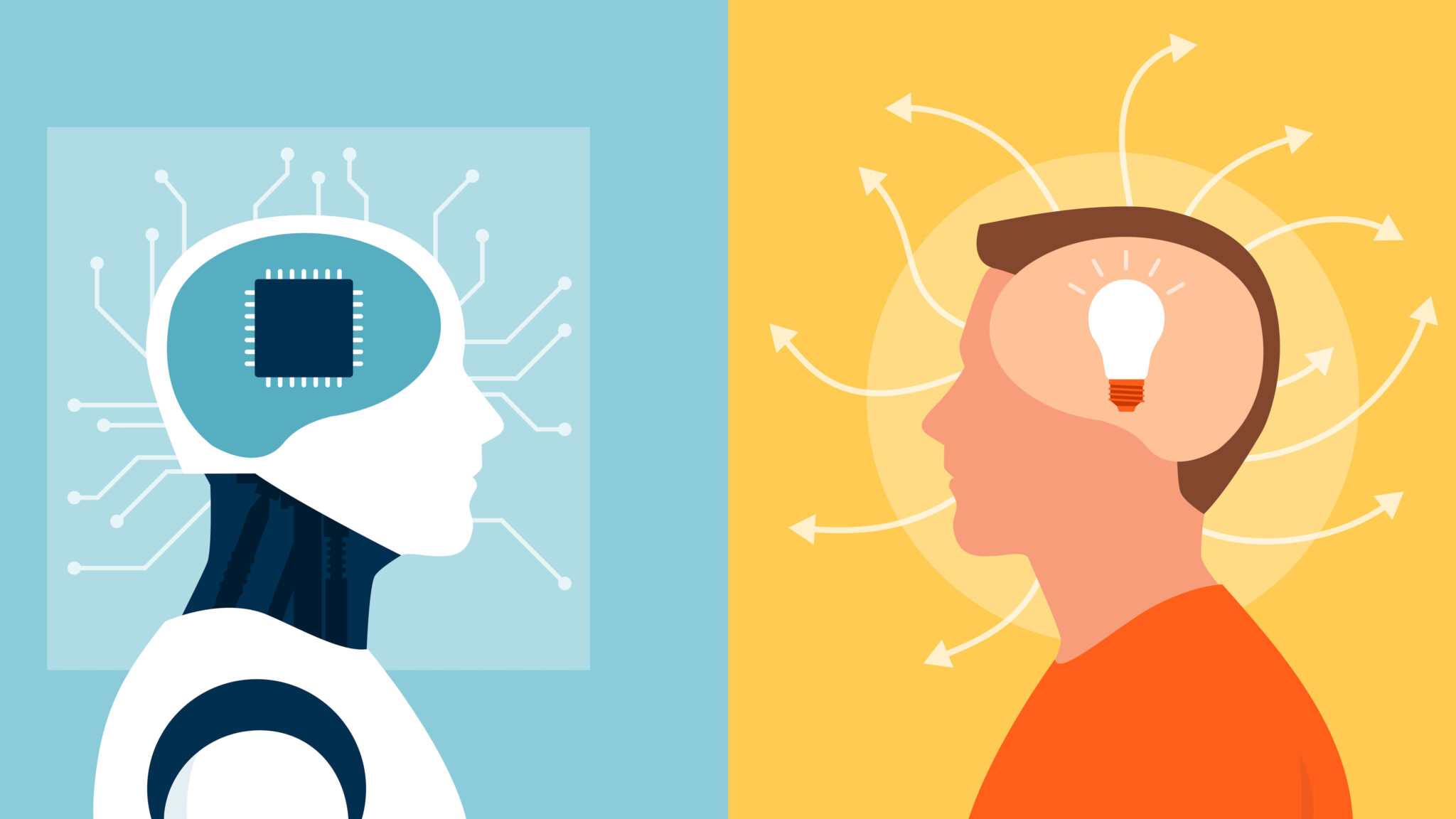
Why scalable AI ideation fails, and how to fix it.
Listen to this article:
AI innovation has a motivation problem. Generating an idea with AI is only the first leg of a relay race that requires refinement, gathering support, and persistence when problems arise. But if an employee feels no psychological ownership over an idea, no sense that an idea is meaningfully theirs, who will step up to push it through the organizational pipeline towards successful implementation? That’s the challenge explored in the new working paper “Ideas Are a Dime a Dozen with GenAI, but Who Will Champion Them? Gaining and Losing Idea Ownership in Human-AI Knowledge Work,” co-authored by HBS AI Institute chair and co-founder Karim R. Lakhani. The researchers ran a field experiment inside H&M Group to find out what happens when GenAI enters the ideation process, and how organizations can preserve the human ownership that turns AI-assisted concepts into ideas employees are willing to champion.
Key Insight: AI Ideation at H&M
“The goal of the ideation challenge was to generate new ideas to leverage retail spaces sustainably.” [1]
To study this dynamic, the researchers partnered with H&M Group and ran a ten-day ideation challenge with 403 corporate and retail employees across nine departments and 23 branches. The employees tackled a genuine strategic problem: how to reimagine retail spaces so they create value beyond simply selling more clothes. Everyone used GPT-4o, but employees were randomly assigned to one of three workflows: use GenAI throughout the process, begin with GenAI and finish independently, or begin independently and then use GenAI. Participants spent 15 minutes generating three ideas and another 15 selecting and explaining the most promising one. The proposals had to be feasible within two years and fit within a $100,000 pilot budget. Employees then rated, on seven-point scales, how strongly they felt the final idea belonged to them and how willing they were to promote it through the company’s innovation program.
Key Insight: Whoever Strikes the Match Owns the Fire
“Importantly, we captured how the spark of the initial idea affects the sense of ownership over the final idea.” [2]
The results point to something the researchers call the “spark effect.” Employees who started ideating on their own, before ever touching AI, reported meaningfully higher ownership (about 7%) compared to those who used GenAI from the very first moment. The sense of ownership is driven by who came up with the initial idea: analysis of the human-AI transcripts found that people who started independently were the idea originators 87% of the time, versus 68% for those who used AI throughout, and just 59% for those who ended alone. Natural language analysis of the conversations told the same story: the more that an idea’s language could be traced back to AI’s own phrasing rather than the person’s, the less ownership and championship willingness that person reported. Additionally, simply contributing more text relative to the AI did not predict greater ownership.
The study measured willingness to champion through a self-reported rating collected after the ideation task: employees indicated, on a seven-point scale from “not at all” to “extremely,” how willing they were to promote their idea through H&M’s innovation program. Every one-point increase in an employee’s sense of ownership was associated with a 0.42-point boost in their willingness to champion the idea. Because of this strong connection, starting the ideation process independently (generating ideas on one’s own before turning to AI) had a significant 0.15-point indirect effect on championing.
Key Insight: Ownership Shifts as You Build
“[I]ndividuals may gain ownership over GenAI-generated ideas and lose ownership over their own ideas.” [3]
The story doesn’t end at the first spark. The researchers uncovered two more subtle patterns that can override where an idea started. They found that ownership gain occurred when an employee took an AI-sparked concept and infused it with specialized knowledge and lived experience. The idea became more personally meaningful as employees adapted it to the people, limitations, and everyday routines they understood from their work. These cases represented 12% of the sample. The researchers identified that ownership loss occurred when GenAI took a human-sparked concept and developed it through standardization, abstraction, and generalized assumptions. As the idea became more comprehensive but less connected to the employee’s original experience, the sense of ownership weakened. The researchers documented this kind of loss in 38% of the sample.
Why This Matters
This research suggests that even a brief period of independent thinking at the outset of ideation can be valuable when an idea will later depend on human advocacy. That doesn’t mean that every task or brainstorm needs a protected human-only opening. The next challenge for leaders may be to distinguish between workflows optimized for producing possibilities and those that must also produce ownership, and where in their organizations human ownership materially affects the outcome. By managing that balance, companies can harness the speed of AI without sacrificing the human passion required to bring bold strategic visions to life.
Bonus
AI can create more organizational value, but it can also weaken employees’ sense that their knowledge and contributions still belong to them. Sustainable AI adoption therefore may depend on preserving human ownership and aligning incentives around what workers contribute. For a broad framework on giving employees control over, and a meaningful stake in, the value created from their ideas and knowledge, check out Knowledge Guilds: Who Owns Your Expertise?
References
[1] Lazar, Moran, Hila Lifshitz, Rawan Qadri, Inbal Yahav, and Karim Lakhani, “Ideas Are a Dime a Dozen with GenAI, but Who Will Champion Them? Gaining and Losing Idea Ownership in Human-AI Knowledge Work,” Harvard Business School Working Paper, No. 27-010 (July 2026): 20.
[2] Lazar et al., “Ideas Are a Dime a Dozen with GenAI, but Who Will Champion Them?” 29.
[3] Lazar et al., “Ideas Are a Dime a Dozen with GenAI, but Who Will Champion Them?” 7.
Meet the Authors

Moran Lazar is Assistant Professor at the Coller School of Management, Tel Aviv University.

Hila Lifshitz is a Professor of Management at Warwick Business School and a visiting faculty at Lab for Innovation Science (LISH) at the HBS AI Institute.

Rawan Qadri is a Lecturer and PhD Candidate in Technology Management and Information Systems at the Coller School of Management, Tel Aviv University.

Inbal Yahav is Senior Lecturer at the Coller School of Management, Tel Aviv University.

Karim R. Lakhani is the Dorothy & Michael Hintze Professor of Business Administration at Harvard Business School. He specializes in technology management, innovation, digital transformation, and artificial intelligence. He is also the Co-Founder and Faculty Chair of the HBS AI Institute and the Founder and Co-Director of the Laboratory for Innovation Science at Harvard (LISH).