

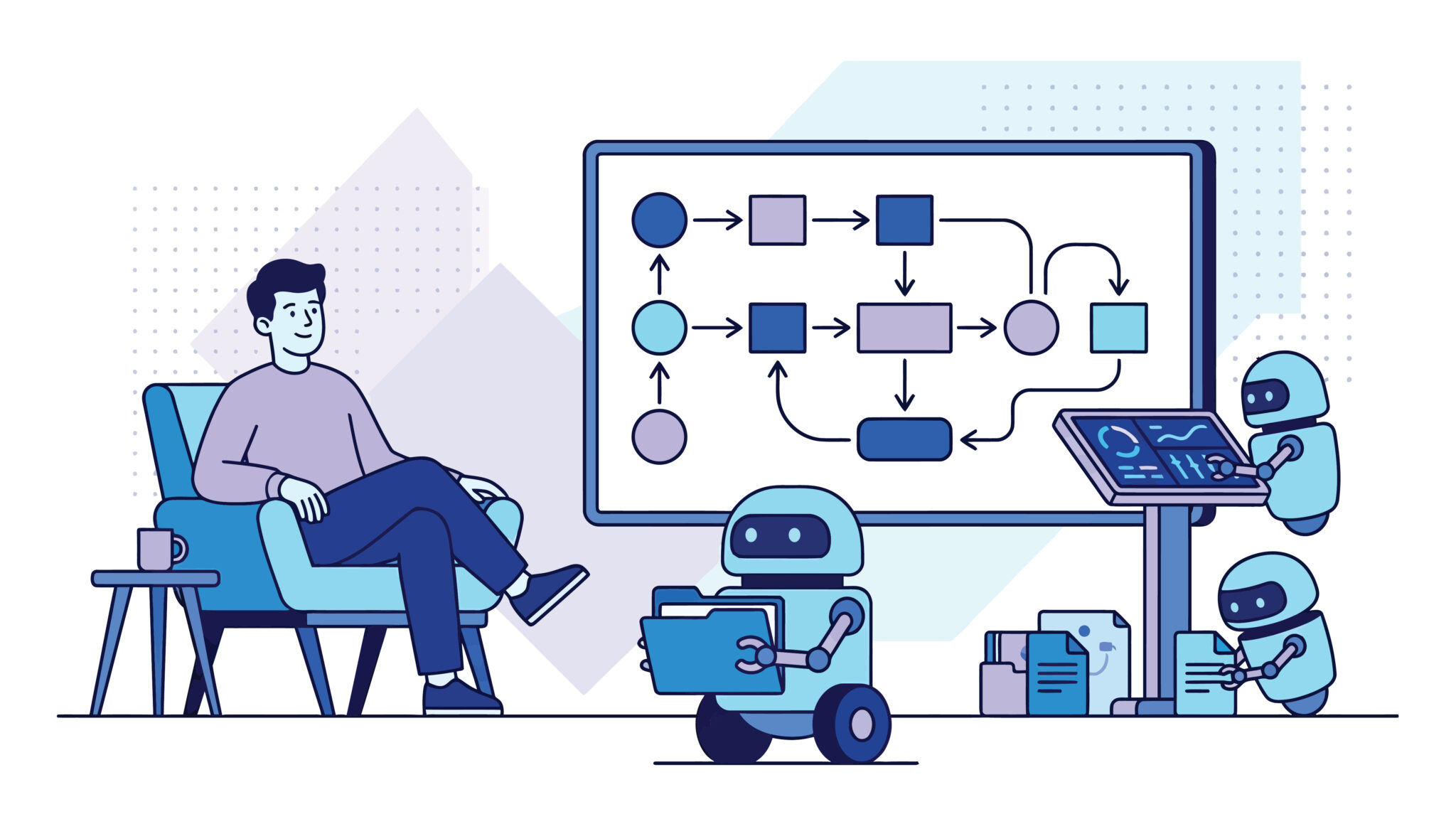
A six-month, cross-industry randomized trial shows how generative AI is reshaping work.
Listen to this article:
The promise of psychologist Mihaly Csikszentmihalyi’s “flow theory” is that people do their best work when they can enter a flow state, or stay deeply engaged in a challenging task without constant interruption. Yet the structure of knowledge work often pulls in the opposite direction: workers move from email to document to meeting and back again, rarely getting long stretches of uninterrupted attention. This makes the arrival of generative AI in the office a practical test of a larger question: can AI alter the rhythms of work, or does it simply add another layer to existing routines? In “Shifting Work Patterns With Generative AI,” a team including HBS AI Institute Associate Christopher Stanton provides early evidence across 66 firms and more than 7,000 workers to examine how access to AI changed day-to-day work behavior.
Key Insight: The Importance of the Firm
“Usage rates varied widely across firms.” [1]
While this study focused on individual adoption habits, one of the most interesting findings related to firm-level usage, which ranged wildly from 6.3% in the lowest-use firm to 75% in the highest-use firm. This gap is striking because all of the participating companies were large firms interested enough in generative AI to join an early study. Due to a lack of access to the necessary internal data, the researchers could not identify the exact causes of this firm-level variation, and they caution that they cannot estimate whether any one factor (such as training, managerial practices, industry, or worker role) caused higher adoption. Still, the strongest predictor was the firm itself, suggesting that the AI adoption story could be less about individual enthusiasm and more about organizational context.
Key Insight: AI Tested in the Messy Reality of Work
“Outside the lab, workers must learn on their own which parts of their job benefit from the use of new tools and gradually change their habits of work.” [2]
Much early academic research on AI has come from controlled lab settings, where participants are handed a specific task, an AI tool, and given guidelines on what to do. Real work and workplaces are messier, and this study was designed to capture that fully. Over the course of September 2023 through October 2024, Microsoft conducted a six-month randomized controlled trial tracking telemetry-level data on how workers actually spent their time, not self-reported sentiment. Half of the participants were randomly granted access to Microsoft 365 Copilot, an AI assistant integrated directly into applications like Outlook, Teams, and Word, while the other half served as a control group. Employees were under no obligation to use AI, letting the researchers observe organic adoption. One of the study’s conceptual contributions is the distinction between two kinds of workplace behavior: those a worker can change unilaterally, and those that require others to change too. For example, reading and drafting emails is a solo act: no one needs to know how you manage your inbox. But deciding when a meeting will take place and how long it runs can’t take place in an individual bubble, and it turns out that this distinction matters for the study’s results.
Key Insight: A Wall Called Meetings
“[W]e see larger changes in behaviors that workers can adjust independently and less movement in behaviors that require coordination with colleagues.” [3]
The headline finding from the study is striking: workers who used Copilot in more than half of the study weeks spent 3.6 fewer hours per week on email, a 31% reduction from a pre-period average of 11.7 hours weekly. On the other hand, even though Copilot helped with meetings by producing transcripts, creating summaries, and surfacing action items, workers kept attending the same meetings for the same durations. The reason, the researchers argue, is structural: changing meeting behavior requires collaborative coordination and joint expectations—aspects of work that individual AI access is insufficient to alter. Document work sat between the two extremes, but in a different way than one might expect. While collaborative documents were completed roughly 25% faster, individual workers didn’t complete more documents.
Why This Matters
For business leaders, this study challenges two assumptions that can quietly shape AI strategy: that adoption is already widespread once a tool is available, and that productivity gains will appear evenly across the organization. The evidence suggests a more uneven reality. That means leaders should be careful not to confuse access with adoption, or isolated efficiency with transformation. The strategic question is not just how to deploy AI, but where it is actually taking hold, which workflows it is improving, and what organizational support is needed to turn small pockets of reclaimed time into broader changes in how work gets done.
Bonus
To see how agentic AI takes productivity a step further, read The Agentic AI Reality Check next for a look at tools that can plan, act, and complete multi-step tasks across real digital environments.
References
[1] Dillon, Eleanor W., Sonia Jaffe, Nicole Immorlica, and Christopher T. Stanton, “Shifting Work Patterns with Generative AI,” NBER Working Paper Series, No. 33795 (May 2025): 2.
[2] Dillon et al., “Shifting Work Patterns with Generative AI,” 1.
[3] Dillon et al., “Shifting Work Patterns with Generative AI,” 2.
Meet the Authors

Eleanor Wiske Dillon is a Principal Researcher at Microsoft Research.

Sonia Jaffe is a Principal Economist at Microsoft Research.
Nicole Immorlica is Senior Principal Researcher at Microsoft Research.

Christopher T. Stanton is Marvin Bower Associate Professor at Harvard Business School and an Associate at the HBS AI Institute.
Watch a video version of the Insight Article here.