

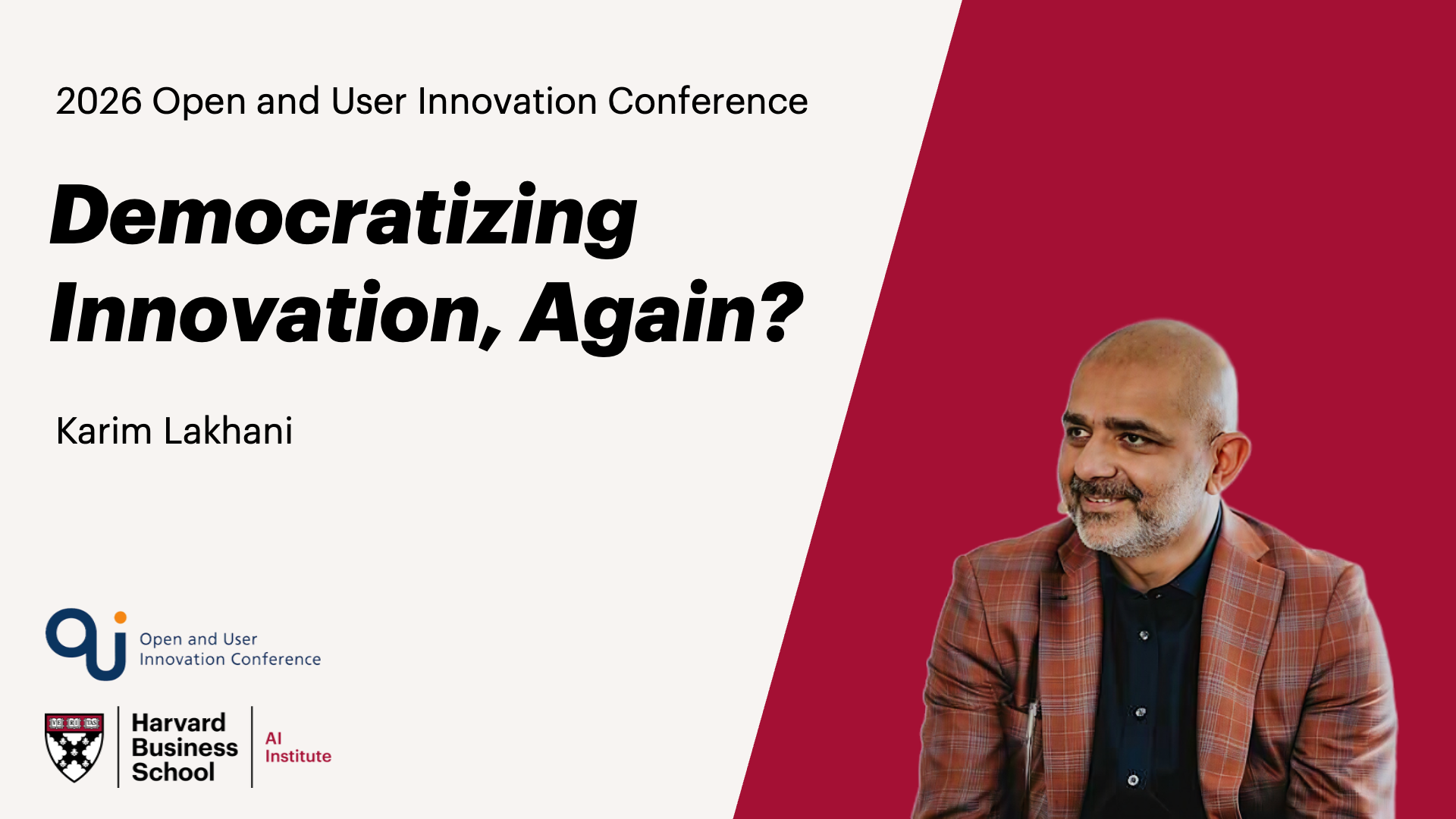
The HBS AI Institute’s co-founder explains how AI is redrawing the boundaries of economics, talent, and innovation.
On Monday, July 27, the HBS AI Institute’s Karim R. Lakhani opened the 2026 Open and User Innovation (OUI) Conference with a talk connecting the rapid evolution of AI to a deeper shift in how expertise is created, distributed, and combined inside organizations. The starting point of “Democratizing Innovation, Again?” was a mismatch: AI capabilities have been improving exponentially, while most companies are absorbing them linearly. To understand the consequences, Lakhani and his collaborators have sought to treat AI almost like a new pharmaceutical, one whose efficacy, side effects, and conditions for best use require rigorous testing.
Key Insight: “[E]very problem is being recast as an AI problem.”
Karim R. Lakhani
The AI surge reflects two shocks arriving at once. On the supply side, the cost of innovating with AI is falling as model performance rises. Work that once required large teams, specialized infrastructure, and extensive computing resources can increasingly be accessed through online services. Lakhani cited the cost of GPT-3.5 tokens falling from roughly $20 per million to about seven cents, alongside an estimated $715 billion in capital spending in 2026.
On the demand side, organizations are reframing challenges across departments as AI problems. The combination is accelerating investment and experimentation. To illustrate the rapid pace of change, Lakhani contrasted a crude 2023 AI video with a highly polished 2026 demo ad. The impressive newer clip showcased work that once required a ten-person agency six months to produce, but can now be completed by two people in a week. The same underlying systems can increasingly perform both technical and creative work.
Key Insight: “AI is lowering the cost of expertise.”
Karim R. Lakhani
Earlier digital technologies made information, music, and software cheaper to distribute. Lakhani argued that AI is doing something similar to expertise. Focusing on the results of three important studies from the HBS AI Institute (1, 2, 3), Lakhani first explained that in a creative problem-solving experiment, human teams outperformed individual humans, but individual humans working with AI could outperform those human teams. In another study, generative AI helped participants complete about 12% more tasks and produce work rated 40% higher in quality. Notably, below-average performers improved by a massive 31%. However, on analytical tasks beyond an AI model’s capabilities at the time, AI users performed roughly 20% worse. Lakhani and his collaborators term this uneven boundary of AI capabilities the “jagged technological frontier.” In the third study, AI allowed workers to perform effectively on tasks outside of their core role and responsibilities. For example, non-technical workers with AI were able to produce solutions that were just as technical as R&D workers.
Key Insight: “Selection is now going to become a bottleneck.”
Karim R. Lakhani
Innovation has traditionally rested on a challenging dynamic: users possess hard-to-transfer knowledge about their needs and solution expertise is costly to acquire. AI weakens the second constraint without eliminating the first. Specialized solution capabilities may become widely accessible, but understanding the real problem and its context can remain stubborn barriers. Easier generation also creates harder practical questions. One practical question Lakhani named was reliability: organizations need stronger selection and review systems because AI can make incorrect answers sound convincing. Another was evaluation: as evidence about an innovation’s success may arrive much further down the road. Finally, there was innovation: as AI outputs also tend to converge, threatening the variation that produces breakthroughs.
Why This Matters
As credible solutions become cheaper to produce, advantage shifts toward framing the right problems, preserving diverse approaches, testing ideas rigorously, and mobilizing people to carry the best ones forward. For business leaders and executives, those are ongoing management challenges, rather than one-time technology rollouts, and success will come from building the right judgment, workflows, and governance to match the moment.
Meet the Speaker

Karim R. Lakhani is the Dorothy & Michael Hintze Professor of Business Administration at Harvard Business School. He specializes in technology management, innovation, digital transformation, and artificial intelligence. He is also the Co-Founder and Faculty Chair of the HBS AI Institute and the Founder and Co-Director of the Laboratory for Innovation Science at Harvard (LISH).
Watch a video version of the Insight Article here.